FIRST CLASS GALACTIC — MILITARY DIVISIONSPECTER-1
LONG-RANGE HIGH-IMPACT INTERCEPTOR
Smaller. Faster. Deadlier than the Ovalion. One pilot. Scalar drive. Neural interface. Scalar pulse cannon. 0.04c maximum velocity. Designed to end an engagement before the enemy knows it has begun.
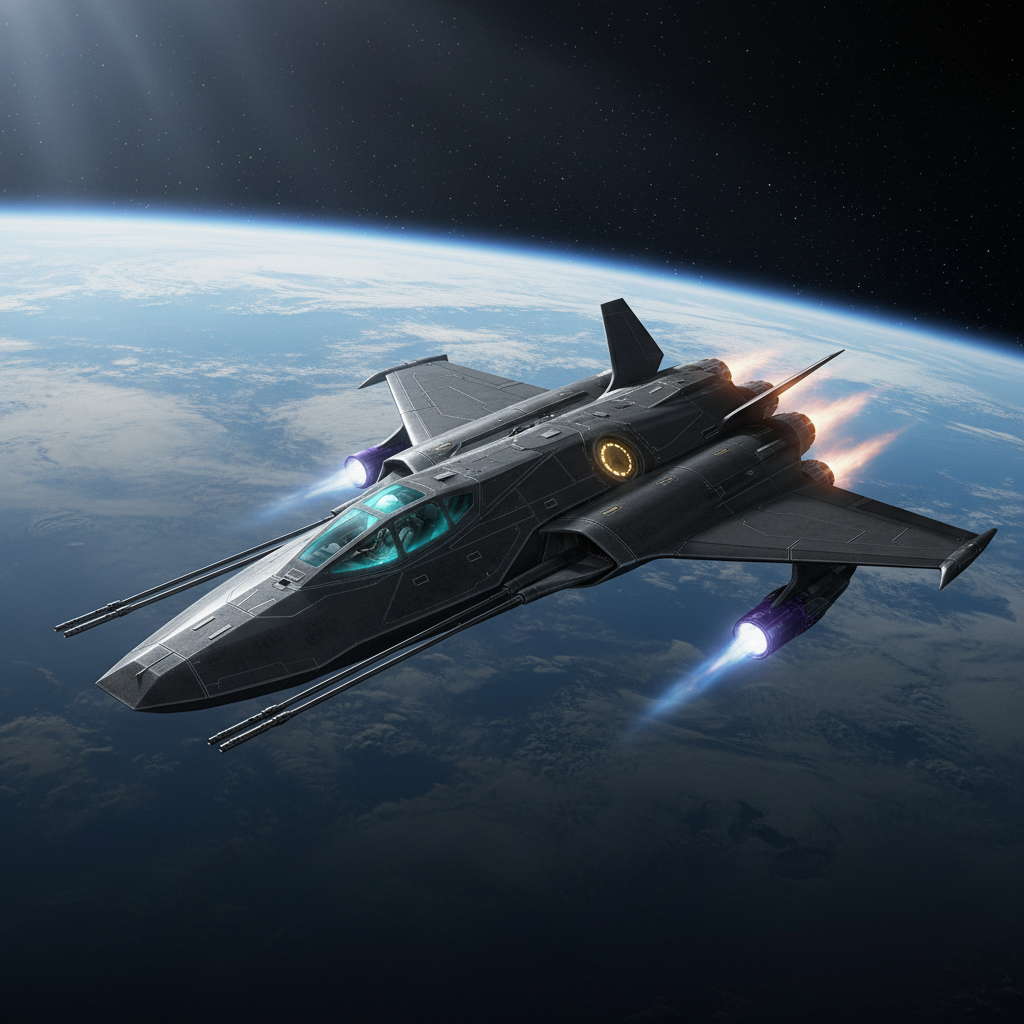
SPECTER-1 INTERCEPTOR · LOW EARTH ORBIT · FIRST CLASS GALACTIC MILITARY DIVISION
— Specter-1 · Three-View Engineering Schematic —
TOP VIEW — DORSAL PLAN
SIDE VIEW — STARBOARD PROFILE
FRONT VIEW — BOW / NOSE-ON
28 m
Length
0.04c
Max Velocity
2.4M km
Range
180 MW
Strike Power
ENGINEERING DRAWINGS — SPECTER-1
SP1-001 · PLAN VIEW (TOP ELEVATION)
SP1-002 · SIDE ELEVATION (STARBOARD)
SP1-003 · INTERNAL LAYOUT — MID CROSS SECTION
ALL DRAWINGS CONCEPT REFERENCE ONLY · FIRST CLASS GALACTIC · OPEN SOURCE · 2025
Physical Depiction & Internal Architecture
HULL FORM & GEOMETRY
Configuration
Cranked double-delta with swept variable-geometry outer panels
Fuselage Cross-Section
Flattened elliptical — 5.2 m tall × 6.8 m wide at widest point amidships
Nose Geometry
Ogival cone — 3.2 m length — houses phased scalar sensor array in tip fairing
Wing Sweep (inner delta)
72° leading-edge sweep — fixed — carries all primary hardpoints
Wing Sweep (outer panel)
35°–68° variable — extends fully for atmospheric cruise, retracts flush for orbital sprint
Dorsal Fin
Single swept ventral-dorsal stabiliser pair — 3.8 m height — integral ELF antenna embedded in skin
Chine Edges
Sharp leading chines from nose to engine intake — serve dual function: shock management + scalar field shaping
Hull Material (outer skin)
Titanium-graphene composite laminate — 12 mm primary skin — 98% EM transparency for scalar field projection
Hull Material (frame)
Osmium-carbon nanotube spaceframe — 40% lighter than equivalent titanium monocoque — hardened against ELF intrusion
Thermal Coating
Black-body scalar-absorptive ceramic outer layer — emissivity < 0.02 — invisible in IR at operating temperatures
INTERNAL ARCHITECTURE — CROSS-SECTION LAYOUT
Zone A (Nose, 0–3.2 m)
Scalar sensor array, forward phased array, IFF transponder, targeting computer node — all in pressurised avionics bay
Zone B (Forward fuselage, 3.2–10 m)
Dual pulse cannon mounting cradles — lateral feed from capacitor banks — 6 internal missile bays (3 per side)
Zone C (Cockpit, 8–12 m from nose)
Armoured titanium tub — 270° panoramic display shell — neural interface mount — biofield emitter ring at seat base
Zone D (Centre, 12–18 m)
SEG ring assembly — 1.8 m diameter, 0.9 m depth — vibration-isolated on 6-point mount — capacitor bank ring surrounding
Zone E (Mid aft, 18–23 m)
Fuel cell banks (xenon, 1,200 kg), life support module, autonomous AI core, crystal shield node × 8
Zone F (Engine bay, 23–28 m)
4 × vectored ion thruster gimbals — 360° pitch-yaw — scalar drive secondary field coils
Wing Roots
Integral structural spars carry hardpoint loads directly to spaceframe — no separate pylon attachment — zero shear risk
Belly Fairing
Landing gear bay (deployable strut system) + 4 × external hardpoint pylons recessed flush when retracted
SEG CORE — ENGINEERING DETAIL
Ring Diameter
1.8 m — smallest viable production SEG for full mass-reduction envelope
Rotor Configuration
3-ring neodymium-iron-boron array — inner, mid, outer — contra-rotating
Magnet Count
18 / 36 / 72 per ring — sized per Searl reciprocal-of-square law
Resonant Lock Frequency
7.83 Hz Schumann base — harmonic at 14.3, 20.8 Hz active during sprint mode
Output (nominal cruise)
140 MWe — sustains flight systems, shields, comms, and 60% weapons ready
Output (combat)
340 MWe — full weapons, maximum shield, full thrust simultaneously for up to 8 minutes
Output (sprint burst)
640 MWe peak — 8-second maximum — induces mass reduction to 1.8% effective — velocity spike
Thermal Management
Zero waste heat in vacuum — SEG output is direct electricity. Minimal IR signature inherent to design.
Isolation Mount
6-point ferromagnetic damped cradle — decoupled from hull vibration — field symmetry maintained to ±0.003%
COCKPIT & PILOT ERGONOMICS
Seat Type
Zero-G contour shell — custom-fitted per pilot — lateral support for 80g dampened (3g experienced)
Helmet Interface
Full-skull biofield headset — 128-channel EEG pickup — non-invasive — 0.08s thought latency
Display Surface
270° wrap — 12 × micro-display tiles — seamless — outer hull camera array feeds direct feed
Physical Controls
Side-stick + throttle quadrant retained as backup — used by trainees — most pilots set to standby after familiarisation
Biofield Ring
7.83 Hz scalar emitter ring embedded in seat base and overhead arch — maintains pilot coherence at combat stress levels
Ejection System
Full cockpit tub ejection — 0.04 second separation — capsule has 72-hour independent life support + return beacon
Suit Integration
Pilot suit hardwired to cockpit biometrics — HRV, SpO2, cortisol, temperature — AI monitors degradation and escalates to autonomous mode
Cockpit Dimensions
1.8 m wide × 2.1 m long × 1.4 m seated headroom — pressurised to 0.85 atm during deep space ops
Systems Engineering Specifications
Class
Specter-1 Interceptor
Single-pilot long-range high-impact strike vessel
Role
Fighter / Interceptor / Deep Strike
Anti-vessel, anti-satellite, precision planetary strike
Length
28 m
Versus Ovalion 180 m — purpose-built for speed and agility
Width (wing span)
18 m
Variable geometry wings — deploy for atmospheric, retract for orbital
Height
5.2 m
Low-profile fuselage — minimises radar and scalar cross-section
Mass (combat ready)
42 tonnes
Stripped for speed — no crew quarters, no cargo
Crew
1 pilot / optional 1 weapons officer
Single-seat primary config — tandem cockpit variant available
Hull Material
Titanium-graphene monocoque
Same Station Alpha material — 60% lighter than steel equivalent
Scalar Signature
Class-1 Stealth — 98% field suppression
Scalar dampener coil reduces EM and etheric detection to near-zero
Operational Range
2.4 million km unrefuelled
Earth to Moon and back × 6 — or sustained LEO patrol for 90 days
ENGINEERING NOTES
The Specter-1 is the blade where the Ovalion is the warship. Designed around a single principle: get there fast, hit hard, vanish. Every gram of mass is justified — no redundancy that does not serve lethality or survival. The vessel is optimised for the pilot — biofield-integrated cockpit, Schumann-locked neural interface, and a SEG core dimensioned precisely to the mission envelope.
SPECTER-1 vs OVALION — COMPARISON
ATTRIBUTE
Length
Mass
Power Output
Crew
Role
Max Speed
SPECTER-1
28 m
42 t
340 MWe
1–2
Fighter / Strike
0.04c
OVALION
180 m
8,400 t
12 GWe
120
Warship / Carrier
0.01c
— SERGEANT'S FIELD NOTE —
"The Specter-1 is not a weapons platform. It is an argument-ender. One vessel. One pilot. One scalar pulse. The purpose is not destruction — it is absolute deterrence. When the adversary knows this vessel exists and what it can do, the argument never starts."